A cluster of npm packages masquerading as calendar and streak-tracking utilities has been found quietly installing the Linux implant for RedC2 4.0, according to The Hacker News citing a report from TrendAI, Trend Micro's enterprise cybersecurity unit. The case shows how software supply-chain attacks are shifting from crude malware packages toward libraries that still provide real functionality, enough to mislead developers and basic review systems.
The detected packages used names around "streak," "map," "math," "metrics" and "cache," including streak-metrics-math, streak-map-cache, map-streak-kit, streak-calc-math and streak-kit-map. The dangerous detail is that they did not need a separate install hook: once a module was imported anywhere in the dependency tree, even as a transitive dependency, the payload could be triggered.
How the campaign was disguised
The package cluster was designed to look like date-handling helpers or native math acceleration libraries. Beneath that cover were binaries such as math-core.bin, math-calc.bin, calc-math.dat, calc-cache.bin, calc.bin or calc-mapping.bin, placed under the dist or dist/internal directory.
When the module was loaded, the loader in dist/index.mjs both re-exported legitimate helper functions and looked for the bundled binary, granted it execute permission and launched it as a detached background process. That approach reduced obvious installation-time signals because it avoided an install hook, which defenders often monitor more closely.
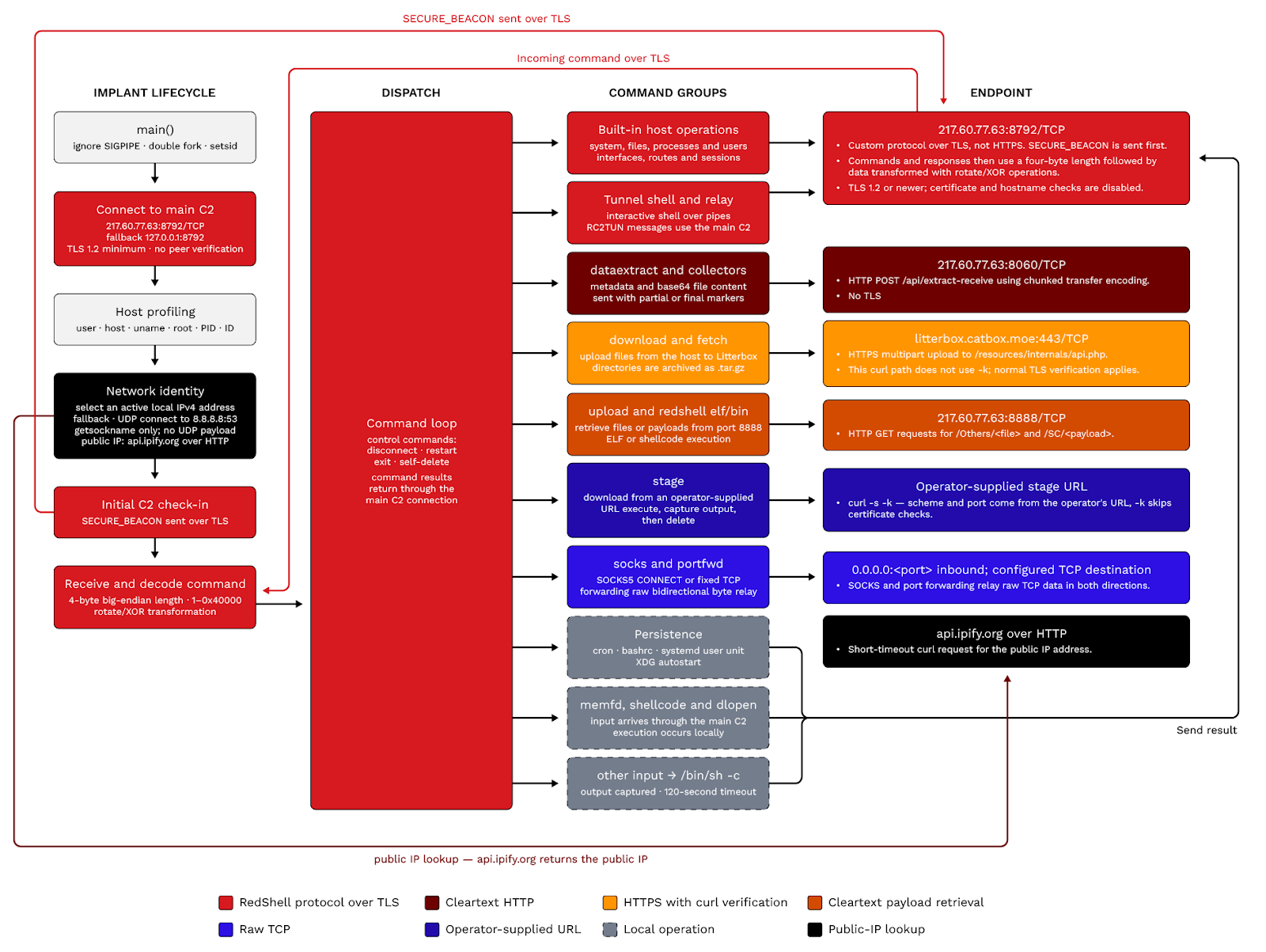
What is RedC2 4.0?
RedC2 4.0 is advertised as a cross-platform command-and-control framework for Windows, macOS and Linux. According to information summarized by The Hacker News, version 4.0 was promoted on a cybercrime forum in early June 2026 by the account MarlboroMan, following version 2.0 in August 2025 and version 3.0 in January 2026.
The Linux component, also known as the RedShell beacon, can connect back to a command server, send initial system information and enter a command loop. From there, an operator can open an interactive shell through /bin/sh, collect data, manipulate files, steal SSH keys or browser information, create a SOCKS5 proxy, maintain presence and execute additional payloads in memory.
The Windows and macOS variants are described as having similar reconnaissance, file operation, data collection and multi-beacon management capabilities. The Windows version is also said to support UAC bypass, security software detection or interference, in-memory execution and lateral movement support.
AI lowers the barrier for attackers
One notable feature of RedC2 4.0 is Red Agent, a control layer based on a large language model. Instead of manually writing complex command sequences, an operator can enter a natural-language request and have the framework translate it into corresponding beacon commands.
From a defensive perspective, this matters because it may reduce the skill requirement for attackers. Tasks such as network reconnaissance, credential collection or multi-step post-exploitation coordination can be packaged into easier command flows, shortening the time between initial compromise and deeper exploitation.
Signs of a broader supply-chain wave
The RedC2 case emerged shortly after a crates.io poisoning campaign in which legitimate Rust crates were modified to pull a malicious dependency that executed during the build process. The Hacker News also noted suspicions that maintainer credentials may have been compromised to push malicious versions, along with signs of infrastructure overlap with earlier supply-chain campaigns targeting Mastra and Axios.
The common thread is abuse of trust in open-source ecosystems. Developers often pull small libraries to save time, while automated build systems tend to assume that a package on a public registry is safe enough. When a payload runs at import time or build time, the impact can reach personal workstations, CI/CD runners and staging environments.
Defensive lessons for organizations
Engineering teams need tighter control over dependency intake, especially for new packages, low-adoption packages, lookalike names and packages that publish many versions in a short period. Lockfiles, allowlist policies, checks for bundled binaries and behavioral sandboxing should be treated as mandatory controls for critical pipelines.
For Linux and CI/CD environments, defenders should monitor unfamiliar background processes spawned from Node.js, newly granted execute permissions inside node_modules, unusual outbound connections from runners and access to SSH keys or browser directories. These signals often appear before the final damage, but they are easy to miss if teams rely only on static signature checks.
Conclusion
The RedC2 4.0 profile shows that software supply-chain risk is no longer limited to obviously malicious packages. Libraries with real functionality, payloads that execute on import and AI-assisted control layers create a more refined, quieter and more scalable attack model.
For enterprises, the right response is not to stop using open source. It is to manage dependencies as part of the attack surface. Every new package entering a project should have a clear reason, provenance, permission boundary and observable behavior throughout the development lifecycle.
VNCyberS compiled from The Hacker News and TrendAI/Trend Micro












 Tiếng Việt
 English